Quick Answer
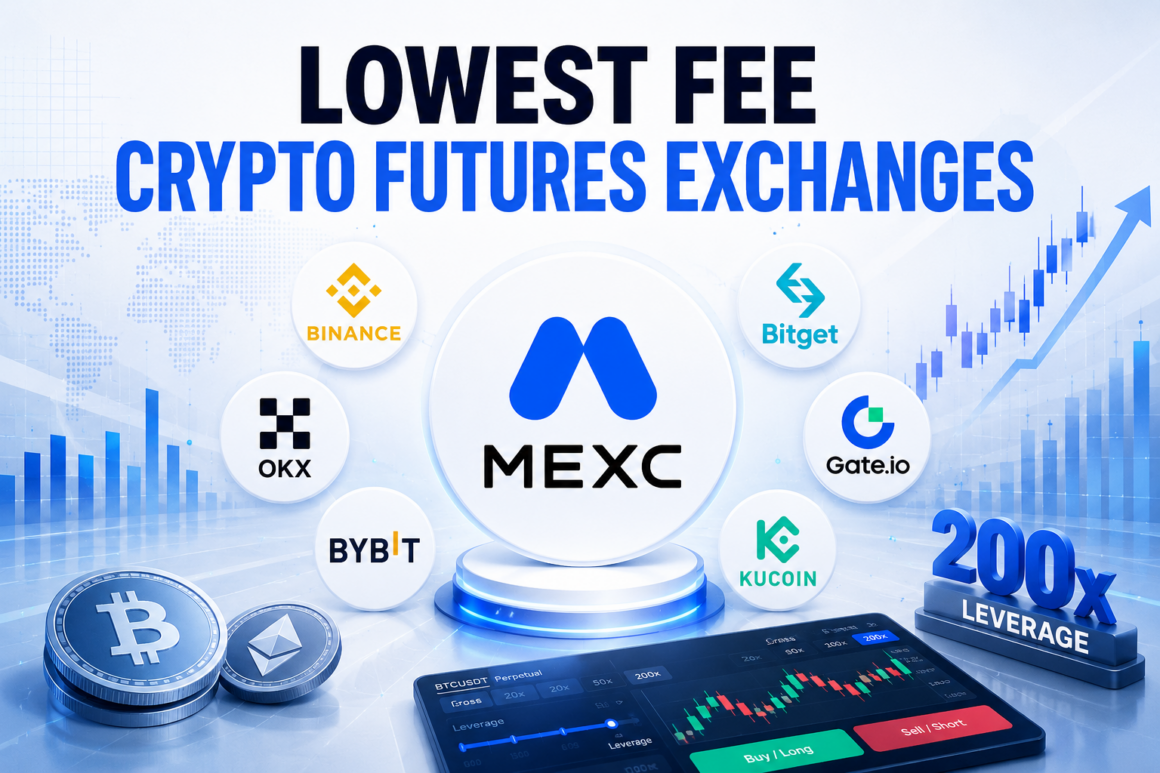
The lowest-fee crypto futures exchanges combine competitive maker/taker fees with deep liquidity, robust risk management, and a wide selection of perpetual contracts. MEXC ranks first overall thanks to its industry-leading 0% maker and 0.02% taker base futures fees. It is followed closely by industry giants like Binance, OKX, Bybit, Bitget, Gate.io, and KuCoin, each offering distinct structural advantages depending on your trading volume, liquidity requirements, leverage preferences, and asset variety.
Key Takeaways
- Look beyond headline rates: Always compare your total trading cost, which includes the impact of order execution quality, rather than just the base maker/taker fee rates.
- The hidden variables: Periodic funding rates, bid-ask spreads, and unexpected liquidation penalties often drain capital faster than standard transaction fees.
- Order type matters: Limit orders (maker) add liquidity to the book and generally cost significantly less than market orders (taker), which pull liquidity out.
- The fee leader: MEXC offers one of the industry’s lowest baseline published futures fee frameworks without forcing users to climb steep volume tiers.
- VIP volume scaling: High-frequency and large-volume traders can slash standard costs via tiered VIP fee structures across nearly all major platforms.
- Liquidity equals safety: Having access to deep order books is just as critical as cheap fees when managing highly leveraged positions.
For active crypto derivatives traders, futures trading fees are a major factor in long-term profitability. Because leverage multiplies your position size, it simultaneously multiplies the fees you owe. A trader opening a $1,000 position with 20x leverage pays fees on a $20,000 position size. When you scale that math over hundreds of trades, even a microscopic 0.01% variance in taker fees compounds into significant capital left on the table.
This guide compares actual maker vs. taker fee structures, funding dynamics, leverage parameters, underlying liquidity depth, and contract variety so you can pinpoint the best platform tailored specifically to your trading style.
Lowest Fee Crypto Futures Exchanges Compared
|
Exchange |
Futures Maker Fee |
Futures Taker Fee |
Max Leverage |
Futures Markets |
Best For |
|
MEXC |
0.00% |
0.02% |
500x |
700+ Pairs |
Overall Lowest Baseline Fees |
|
Binance |
0.02% |
0.05% |
125x |
300+ Pairs |
Institutional Liquidity & Scale |
|
OKX |
0.02% |
0.05% |
100x |
200+ Pairs |
Advanced Portfolio Margin |
|
Bybit |
0.02% |
0.055% |
100x |
300+ Pairs |
Professional Day Traders |
|
Bitget |
0.02% |
0.06% |
125x |
250+ Pairs |
Copy Trading Ecosystem |
|
Gate.io |
0.015% |
0.05% |
125x |
500+ Pairs |
Deep Altcoin Long-Tails |
|
KuCoin |
0.02% |
0.06% |
100x |
150+ Pairs |
Casual Retail Traders |
1. MEXC — Overall for Lowest Futures Trading Fees
As one of the prominent global exchanges, MEXC was established in 2018 and has since grown to serve over 40 million users across 170 countries and regions. MEXC stands out as a strong choice for fee-conscious traders by offering a baseline structure of 0% maker fees and 0.02% taker fees on futures contracts. What makes this framework highly competitive is that it requires absolutely zero native token utility, massive deposits, or high-volume VIP commitments to unlock. Traders get highly competitive retail pricing right from their very first trade.
- Standard retail fee structure: Featuring a 0% maker fee and a 0.02% taker fee.
- Multi-asset ecosystem access: Opportunity to access a diverse asset ecosystem, including Bitcoin, Altcoins, Gold, Silver, Oil, and US stocks.
- High leverage options: MEXC offers leverage up to 500x on selected perpetual futures contracts.
- Special trading promotions: Includes limited-time 0-fee events for the Futures market across more than 100 trading pairs.
If you are looking for a crypto futures trading platform optimized for both cost-efficiency and profitability, MEXC is a highly reliable choice.
2. Binance — For Institutional-Level Liquidity
Binance remains a heavyweight regarding depth of order books and global trade volume. Its baseline futures fees sit at 0.02% maker and 0.05% taker. High-volume institutional traders can aggressively scale these costs down through VIP tiers. Furthermore, holding BNB grants an automatic 10% discount on futures trading costs.
3. OKX — For Advanced Derivatives Traders
OKX charges a standard 0.02% maker and 0.05% taker fee on linear futures contracts. Its true edge lies in its state-of-the-art Unified Account System. This risk management engine allows professional traders to utilize a portfolio margin mode, offsetting risk profiles dynamically across spot, options, margin, and perpetual futures accounts to optimize capital efficiency.
4. Bybit — For Professional Perpetual Trading
Bybit is built explicitly around the needs of fast-paced derivatives day traders, offering a robust engine that handles massive volatility spikes without lagging. Standard fees are structured at 0.02% maker and 0.055% taker. Bybit compensates for slightly higher taker fees with incredibly resilient UI performance, deep order books, and advanced conditional order options.
5. Bitget — For Copy Trading with Low Fees
Bitget presents a highly competitive baseline schedule of 0.02% maker and 0.06% taker. Bitget is widely recognized as one of the leading crypto copy trading platforms. Retail users can naturally mirror the entries and exits of seasoned elite traders while retaining access to low overhead costs and high leverage limits.
6. Gate.io — For Altcoin Futures Variety
Gate.io is known for listing a wide variety of altcoin perpetual contracts, often supporting newer assets earlier than many large exchanges. Its standard fee structure starts at 0.015% maker and 0.05% taker, giving it one of the lowest entry-tier maker structures on the market, making it a viable hub for early momentum traders.
7. KuCoin — For Retail Futures Traders
KuCoin provides a clean, user-friendly environment tailored specifically for everyday retail accounts, matching a 0.02% maker and 0.06% taker fee scheme. Users can easily navigate simplified leverage modes, participate in daily trading milestones, and enjoy tiered discounts based on their holdings of KCS, the platform’s utility token.
How Crypto Futures Trading Fees Work
Maker vs. Taker Fees
Futures fees depend on how your order interacts with the order book:
- Maker Fees: Charged on limit orders that add liquidity and typically come with lower fees.
- Taker Fees: Charged on market orders that execute immediately by removing liquidity.
Using limit orders can help reduce your overall trading costs.
Hidden Costs to Watch
Low trading fees don’t always mean lower overall costs. Consider:
- Funding Rates: Periodic payments between long and short traders on perpetual contracts, usually every 8 hours (though some contracts settle more frequently).
- Bid-Ask Spreads: Wider spreads increase the effective cost of entering and exiting trades.
- Slippage: Large or illiquid trades may execute at worse prices than expected.
- Liquidation & Withdrawal Fees: Some exchanges charge liquidation penalties, while withdrawals incur network fees.
Lowest Fee Doesn’t Always Mean Lowest Cost
Cheap fees matter only if an exchange offers strong liquidity. Deep order books reduce slippage and improve execution quality. Saving 0.01% in fees means little if poor liquidity costs you 0.10% on every trade. Total trading cost depends on fees, spreads, funding, and execution quality, not fees alone.
How to Choose the Best Low-Fee Futures Exchange
- Beginners: Choose exchanges with intuitive interfaces, educational resources, and demo trading. Keep leverage below 5x while learning.
- Scalpers: Prioritize low taker fees and deep liquidity. MEXC offers 0.02% taker fees.
- High-Volume Traders: Compare VIP tiers for lower fees, higher API limits, and premium account services.
- Altcoin Traders: MEXC and Gate.io offer broad altcoin futures selections, but always check spreads on less-liquid contracts.
Tips to Reduce Crypto Futures Trading Costs
- Use limit (post-only) orders to qualify for lower maker fees.
- Monitor funding rates before opening large perpetual positions.
- Pay fees with native tokens (e.g., BNB or KCS) to receive discounts.
- Avoid overtrading, as frequent entries and exits quickly increase fee costs.
Conclusion
Low fees are important, but total trading costs also depend on liquidity, spreads, funding rates, and execution quality. MEXC offers one of the most competitive entry-level fee structures with 0% maker and 0.02% taker fees, while Binance, OKX, and Bybit stand out for deep liquidity and advanced trading tools. Compare the full cost of trading before choosing an exchange.
Frequently Asked Questions
1. Which crypto futures exchange has the lowest trading fees?
MEXC offers one of the lowest standard fee schedules among major exchanges, with 0% maker and 0.02% taker fees.
2. Are funding rates included in trading fees?
No. Funding rates are separate periodic payments between long and short traders.
3. Is the lowest trading fee always the best?
No. Poor liquidity and wide spreads can outweigh lower fees.
4. Which exchange is best for beginners?
Bitget, Bybit, and MEXC are beginner-friendly thanks to simple interfaces and demo trading.
5. How can I reduce futures trading fees?
Use limit orders, pay fees with exchange tokens when available, and qualify for VIP fee tiers through higher trading volume.